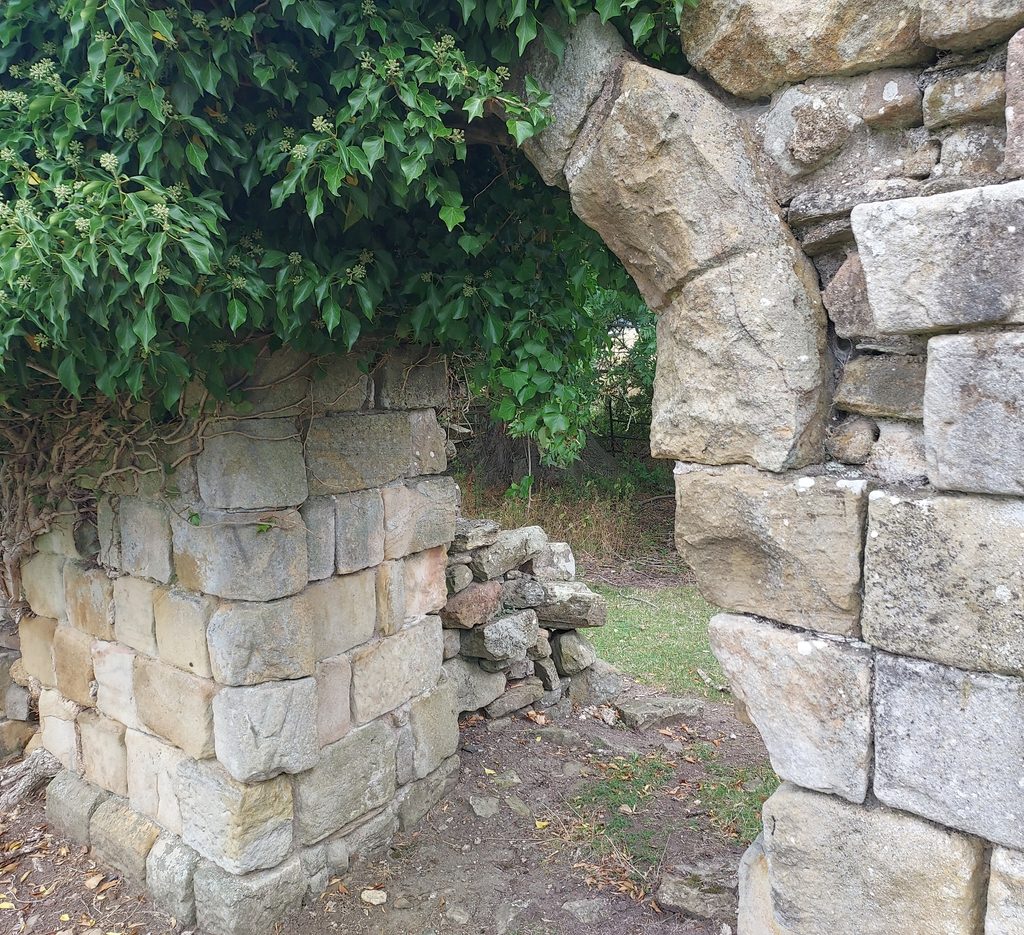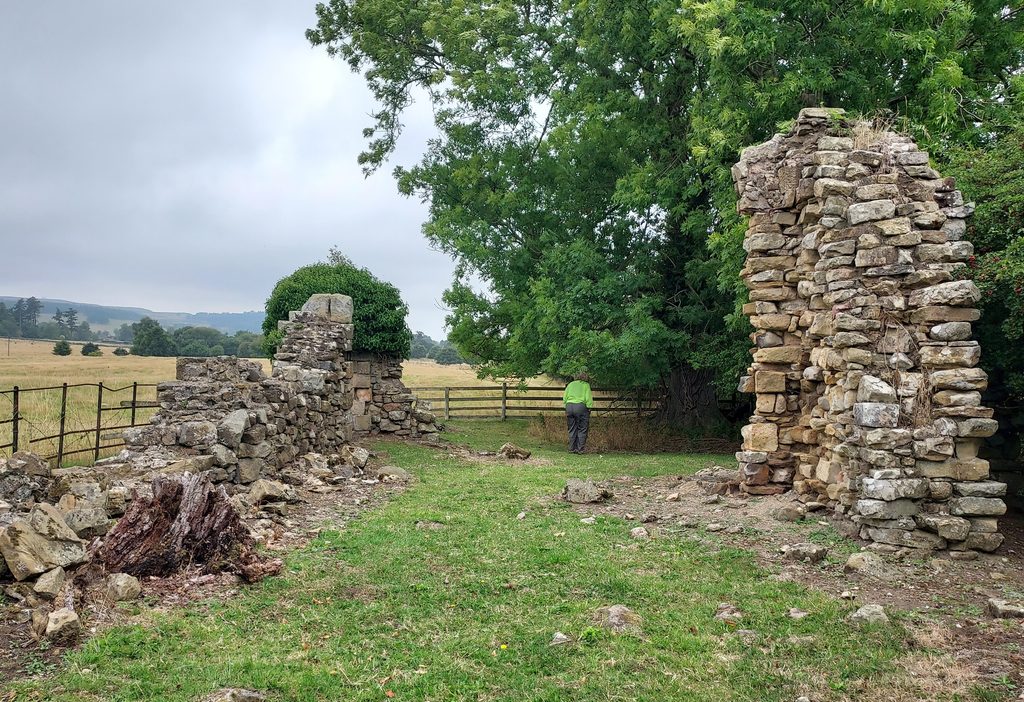
St Leonard’s Hospital (NU 18778 14375) was founded sometime between 1193 and 1216 by Eustace de Vescy, the grandson of the founder of Alnwick Abbey. The hospital was said to be on the site close to a spring known as ‘Malcolm’s Well’ where King Malcolm III of Scotland was killed at the battle of Alnwick in 1093.
The hospital was an independent institution when founded, but was annexed to Alnwick Abbey in 1376. The last documentary reference to the hospital is in 1457 and it is believed to have fallen into disuse before the Reformation and subsequently all trace of the building became lost.
In 1845 the field, then known as Radcliffe’s Close, was ploughed. Foundations of a chapel and other buildings, carved stones, a holy water vase, an ancient well, a burial ground, stone coffin, and upwards of twenty skeletons were discovered. In 1848 the site was investigated by George Selby and William Dickson at the request of Algernon, 4th Duke of Northumberland. A sketch plan of the chapel and other buildings discovered was made at the time (see below)
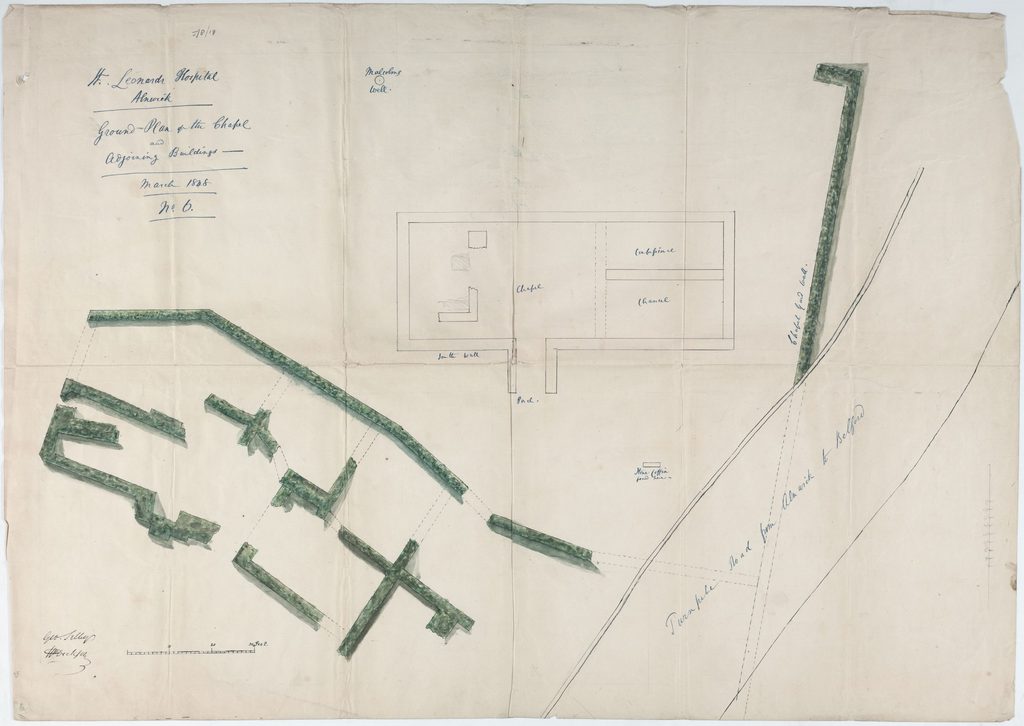
The chapel consisted of a nave and chancel, the former being 22ft long x 27ft wide, and the latter 15ft long x 16ft wide; at the west end appears to have been a chamber 13ft long. Foundations of the domestic buildings are traceable near the chapel on the south side.
The surviving worked stone from the chapel was collected and drawn and it was decided to re-erect parts of the chapel as a permanent monument. This work was carried out by local mason Mr Thomson and the Duke’s architect, F. R. Wilson. The resultant monument (or folly, depending on how you look at it) is a scheduled monument and listed building (grade II).
In 1975, staff and students from Alnwick County Secondary carried out a small excavation on the site, partly as a conservation exercise and also to better understand the form of construction of the rebuilt ruin. It was discovered that masonry from other sources was included in the rebuild, along with the stones originally recovered from the chapel site. A report on the excavation was compiled by Tom Pattinson (a teacher at Alnwick County Secondary School). The report may be found on the website of the Alnwick and District Local History Society and a copy is reproduced HERE.
Although the standing ruin is not an antiquity (however, a plinth course on the south side at ground level may be original), the chapel site and its surrounding archaeological features are valid elements which aid our understanding of the medieval history of Alnwick and Alnwick Abbey.
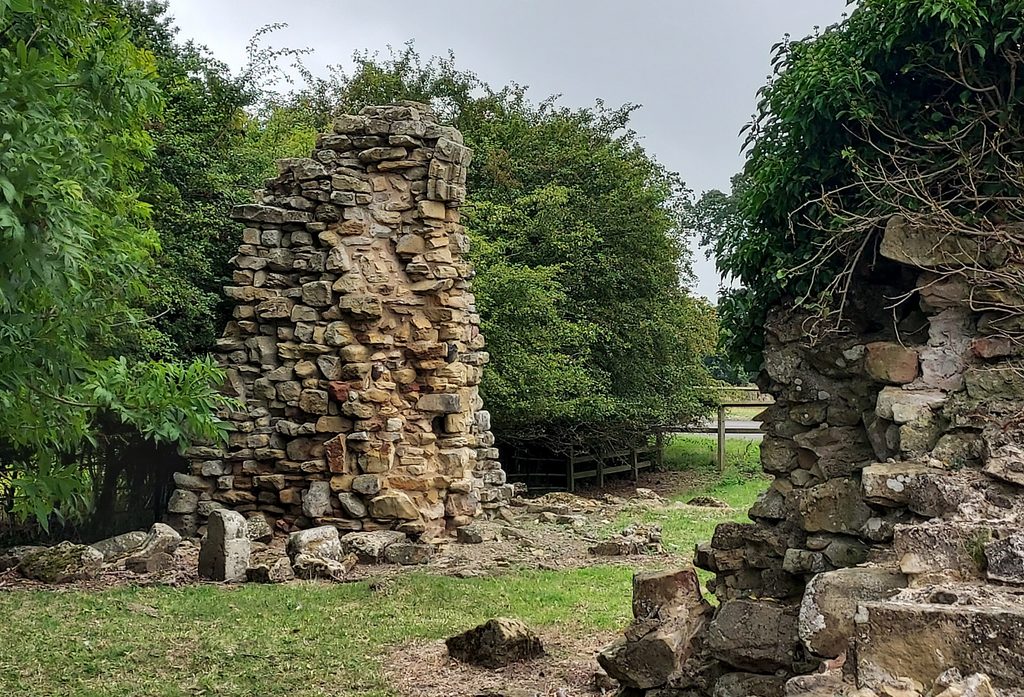
Two views of the St Leonard’s chapel ruin – Left the remains of the reconstructed ‘chancel arch’ – some voussoirs have fallen – and below, the reconstructed doorway in the south wall.