The best history of Bayham is that written by S. E. Rigold around 1974 and published in the DoE guide to Bayham Abbey. I have reproduced the relevant section of his text verbatim, below:
ORIGINS AND FOUNDATION
Bayham Abbey was the product of the union of two inadequately provided and failing foundations, both founded about 1182, and arranged in the first decade of the thirteenth century. The change was certainly for the better; the solitude of the new site at Bayham was in the depths of the west Weald which were beginning to be ‘opened up’, so that the lands of Bayham ultimately became quite valuable. It deserved its alternative name of Beaulieu. By this date, when the famous late Cistercian house of the same name in the New Forest was also founded, beauty rather than desolation of surroundings had begun to weigh with monastic founders. Bayham lay on the boundary of Kent and Sussex and, more significantly and like more than one other Premonstratensian house, on the boundary of two dioceses, befitting its exemption from both.
The two contributory monasteries were Otham, near Hailsham, in Sussex and Brockley, near Lewisham, in Kent but near the Surrey border. The names of the canons indicate that they continued to be recruited from both counties but, of those that made the grade of abbot, most came from north-west Kent and the lower Medway. Since both contributories had a different mother-house, Bayham, to save ill-feeling but ultimately to her advantage, was adopted as a daughter of Prémontré herself, a privilege shared only in England by St Radegund’s, near Dover. Even Newhouse was only affiliated to Licques, near Calais.
Otham had been founded by Ralph of Dene (West Dean, near Seaford),a subtenant of the castlery of Pevensey, with the help of the family of the Brade in Hellingley, whose heirs kept the right of appointing one canon. Neither was very wealthy, but the woods of the Rape of Pevensey lay eastward around Bayham, and the founder’s daughter and ultimate heiress, Ela, married a Sackville, who came from Essex but took as his share in ‘developing’ the Weald, the estate of Buckhurst on the upper Medway. …
Brockley had been founded by an agreement between Michael of Thornham, and Juliana widow of Hugh Bigod, Earl of Norfolk, and of the last Walkelin Maminot, holder of one of the greatest ‘honours’ attached to Dover Castle. Michael had managed her Kentish estates as seneschal and his relatives were, for a short time, an important knightly family with their own castle at Thornham, near Maidstone. …
Their estates in this part of the Weald included the actual site of Bayham, which was provided by Robert de Thornham, brother of Michael, thereby earning him the first place among the founders of Bayham, though not to the exclusion of his forerunners. He may have been buried here and the arms of the abbey were adapted from his. ,,,
Otham was impossibly damp and inhospitable. It is not clear what was amiss with Brockley, but Robert de Thornham was considering moving the canons to Bayham by 1205 and Ela de Sackville, a relation of his by marriage, agreed to marry the convents too. The canons of both had arrived at Bayham by 1211, possibly by 1208, with the buildings no doubt then complete enough to receive them and Jordan, the ex-abbot of Otham, as first abbot of the combined house.
[A summary of Bayham foundation charters etc can be found HERE]
HISTORY
Bayham at once assumed the prestige proper to a daughter of Prémontré. This owed much to energy and talents of Reginald, the second abbot, who not only acted as commissary for the abbot of Prémontré and travelled in France on the King’s business, but was appointed a special, but ill-received, papal visitor of other exempt monasteries. When William, ex-abbot of Dale, the only Englishman to become head of the Order, retired after a difficult tenure but without losing the Pope’s confidence, Abbot Reginald received him at Bayham. …
Then, from about 1260, came a sudden falling-off and Bayham was struck with all the common, worldly diseases of monasticism, We hear of speculation in tithes, of embarrassing corrodies (pensions granted for ready cash) and a prolonged and unnecessary dispute with another house of canons, at Michelham. … There may have been some political manipulation behind it, but Bayham was bullying from a position of strength and, at the same time, betraying her spiritual prestige by a superb and very expensive enlargement of her church and taking high risks to pay for it.
Soon afterwards came Edwards I’s pressure to tax-privileged monasteries and to stop the payments to Prémontré which Bayham had a share in collecting. Most of the English houses banded together and, after a formal protest, effectively obeyed the King; Bayham, as a daughter of Prémontré, stood aloof, yet, for reasons unknown, pursued her own quarrel with the Abbot General which ended in the deposition of Abbot Laurence in 1315. …
The visitation reports of Bishop Redman between 1472 and 1500 show that discipline at Bayham, which had been good under Abbot Chatham, had begun to slacken once more and the convent was well under strength. By 1494, thanks to Redman’s persistence, all was well again.
Bishop Redman’s visitation records are given below (Gasquet, vol 2,pp.71-81)
1472(?): Canons serving churches to return within a week following. State of monastery very unsatisfactory through bad management of foregoing prelates, who have incurred debt to over 900 marks. Very poorly supplied with grain and other necessaries.
3 September 1478: Bishop Redman excommunicates three apostates; urges the abbot to get more members; finds the house greatly dilapidated through the faulty administration of two abbots; the buildings must be repaired at once.
17 July 1488: Bishop Redman deplores the small number of the community, which does not allow the divine office to be said properly; urges mutual obedience; he remits the punishment of one canon who has struck another, on his doing penance.
12 October 1491: Bishop Redman deals with a canon accused of incontinence, who is sent to another monastery for punishment and threatened with perpetual imprisonment; all are ordered to attend at Matins; no one may eat in any house within a league of the monastery; the abbot is not to be too easy in letting canons go abroad.
25 June 1494: Bishop Redman finds one of the canons guilty of incontinence and sends him for seven years to Croxton; another charged in a previous visitation is excommunicated as an apostate; a third did not appear and is cited to do so at Croxton. The abbot is charged to increase the number of his community.
17 October 1497: Bishop Redman finds the house in an excellent state. The new abbot has paid off some of the debt.
29 September 1500: Bishop Redman finds the house in good order; the number of canons should be increased.
DISSOLUTION
Bayham is unusual among the Premonstratensian houses in that it was selected for early closure by Cardinal Wolsey. Of the twenty‑nine religious houses targeted in his initial programme, Bayham was the only Premonstratensian foundation on the list, and it was one of twenty abbeys dissolved during the main phase of Wolsey’s action in early 1525. Its suppression became one of the best‑known of these closures because it provoked an ‘unseemly riot’ on 4 June 1525, when more than a hundred men—‘with painted faces and visures and armed with longbows, crossbows, arrows, swords and clubs’—assembled at the abbey.
The mob installed Thomas Towers as a new abbot and reinstated the expelled canons. They assured the restored community that, should danger arise, they had only to ring the bell and the people would come to defend them. Yet the re‑established abbey survived barely a week. By the following Sunday—just eight days later—the rebellion had been suppressed, the illegal occupation ended, and the canons departed Bayham for good.
Retribution followed swiftly, though it was less brutal than might be expected for the period. Wolsey was not intent on bloodshed. The canons were arrested and provided the names of the rebellion’s ringleaders. Thirty‑one men, mostly from the immediate locality, were indicted and ‘sorely’ punished. Their exact penalties are unrecorded, but several were likely imprisoned; notably, none appear to have been executed. The names and details of the thirty‑one indicted men survive (see list HERE). Strikingly, twenty‑five of them lived in the abbey’s immediate neighbourhood and worked in occupations suggesting employment by, or close dependence on, the abbey. Presumably they believed their dramatic intervention might halt the course of events. It could not—and did not—yet Bayham stands as a precursor to the larger uprisings that followed the suppressions of 1536.
Why did Bayham’s closure provoke a riot when the other twenty‑eight houses were dissolved without recorded dissent? … and unlike many of the others, Bayham was not a failing institution: Bishop Redman’s visitations of 1497 and 1500 found it in good order. Perhaps its contribution to the local economy and community had earned it exceptional public loyalty. Or perhaps the rebellion reflected wider grievances, including resentment of Wolsey’s taxation of the working classes, as much as the loss of the local monastery. We cannot know. What is clear is that, despite the ‘unseemly riot’, Bayham was closed on 11 June 1525, and its monastic life came to an end.
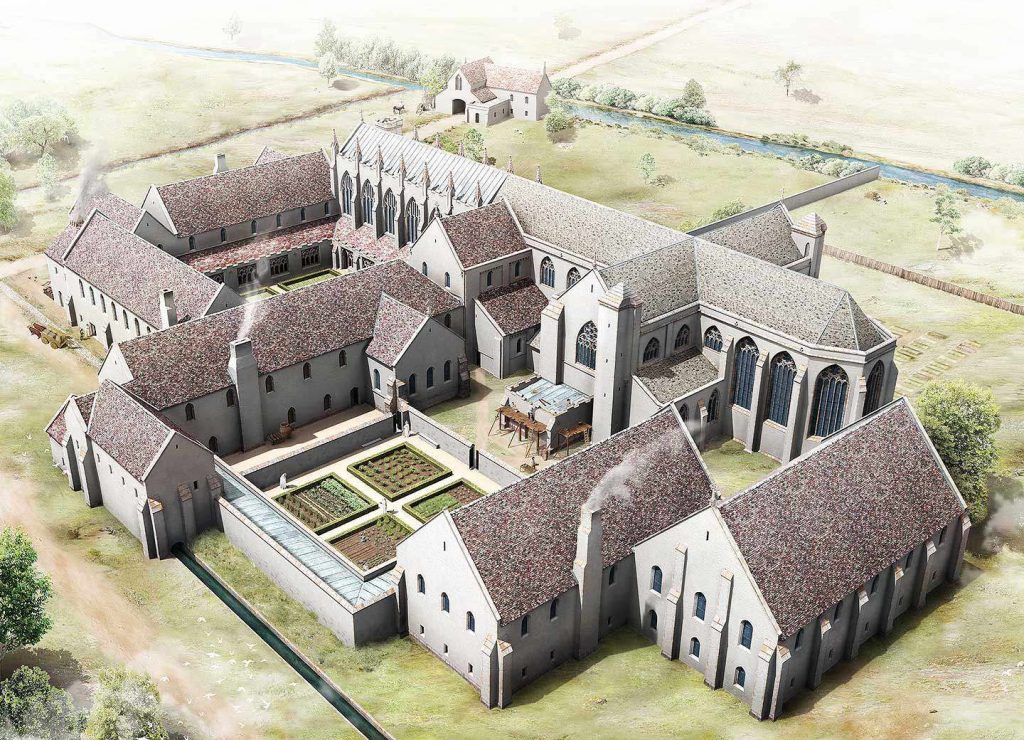
/
- Dissolution References:
- Carter, Michael, 2025, Bayham: The Abbey that Fought Back, The Tablet. See: https://www.thetablet.co.uk/blogs/bayham-the-abbey-that-fought-back/
- Goring, J., 1978, The Riot at Bayham Abbey June 1525, Sussex Archaeological Collections, Vol 116, pp. 1-10.